
Bridging Savings and Sustainability: How Rhema Institute is Transforming Grassroots Economies in Dowa District
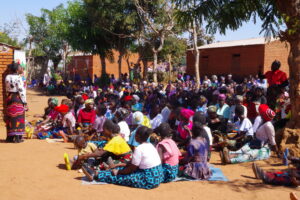
In the face of rising economic pressures and skyrocketing agricultural input costs, rural communities are finding innovative ways to achieve self-reliance. On Wednesday, June 10, 2026, Rhema Institute for Development took a significant step forward in this mission, hosting a massive community engagement session focused on financial literacy, business mentorship, and climate-smart agriculture at Sendeza Village, Mtengowanthenga, in Dowa District.
The targeted awareness session brought together over 500 beneficiaries representing 44 local clubs, all eager to learn how to strengthen their Village Savings and Loan Associations (VSLAs) and integrate sustainable farming practices into their household economies.
For many rural households, VSLAs serve as the primary gateway to financial inclusion. However, saving money is only the first step toward economic mobility. To truly break the cycle of poverty, these savings must be backed by sound business strategies.
Speaking during the engagement, Rhema Institute Project Officer Victoria Mbewe emphasized that financial literacy is the true cornerstone of resource mobilization and grassroots economic empowerment.
“Financial literacy is the ultimate tool for self-reliance,” Mbewe shared with the gathering. “But saving money is only half the battle; our members must also know how to grow it through structured, disciplined business ventures.”
Mbewe urged participants to approach entrepreneurship with strict financial discipline and a proactive mindset. Crucially, she highlighted the necessity of conducting thorough market surveys before launching any business enterprise—a practice that ensures beneficiaries invest in viable markets and safeguard their household incomes against avoidable losses.
For Rhema Institute for Development, the integration of business mentorship and marketing linkages into traditional VSLA models represents a strategic paradigm shift.
Historically, grassroots savings groups have excelled at helping members accumulate small pools of capital. However, without a clear roadmap for investment or direct access to profitable markets, these funds often stall. By deliberately embedding business mentorship into the program, Rhema Institute provides entrepreneurs with the critical acumen needed to manage risks and optimize profits.
Furthermore, establishing marketing linkages bridges the gap between rural producers and competitive buyers. This holistic approach ensures that local initiatives do not operate in a vacuum. Instead, it transitions communities from basic economic survival to sustainable, long-term wealth creation, transforming grassroots savings into vibrant, self-sustaining local economies.
The economic challenges facing Dowa’s farmers extend beyond capital; the escalating cost of commercial farming inputs threatens food security across the region. Addressing this crisis head-on, Limbani Chiusiwa, one of Rhema Institute’s dedicated Village Agents, introduced a powerful, low-cost solution: producing highly effective bio-fertilizer using human urine.
Chiusiwa demonstrated practical methods for preparing and safely applying this organic alternative, showing farmers how they can dramatically boost their field crop yields without relying on expensive commercial brands.
“With skyrocketing commercial fertilizer prices threatening farming impacts in the district, we must look inward,” Chiusiwa reminded the community. “Utilizing locally available resources allows our farmers to cut costs, maximize yields, and safeguard their food security.”
The deep, structural transformation witnessed across these 44 clubs would not be possible without the unwavering commitment of Rhema Institute’s donor partners. Their generous financial and technical backing provides the fuel for these grassroots interventions, turning ambitious developmental concepts into practical, life-changing realities on the ground.
By investing directly in financial capacity building and climate-smart innovations, these partners are helping Rhema Institute move away from short-term relief toward sustainable, measurable growth. This collective generosity is actively creating a massive, positive ripple effect in Lilongwe and Dowa District with one household, one village, and one savings group at a time.
By combining financial discipline with adaptive, climate-smart agricultural techniques, the over 500 beneficiaries in attendance left the session equipped with both the knowledge and the practical tools needed to build resilient households.
Through these deeply integrated interventions, and with the vital support of its global and local partners, Rhema Institute for Development continues to demonstrate that when rural communities are provided with the right mentorship, innovative tools, and market connections, true sustainable development is born from within.