
Rhema Institute for Development(RHID)

Loading

Archives June 2026

Breaking Barriers Through the Stage: How Forum Theatre is Transforming Gender Roles in Dowa

In the heart of Group Village Headman (GVH) Chikuse, nestled within Mononga Village, a lively circle of community members leans in closely. At the center of this circle stands Agness Kalata. Her voice is clear, her gestures are animated, and her mission is profound.

Agness is leading a powerful transformation. She is part of a specialized, four-member local touring theatre group—alongside Martha Ndizo, Jackson Kamakantha, and Limbikani Chiusiwa—trained intensively in Theatre for Development (TfD) and Forum Theatre.

This impactful initiative is brought to life by Rhema Institute for Development, in a proud and vital partnership with Hope for a Child UK. Together, we are using the power of participatory performance to challenge deep-rooted gender inequities, promote women’s empowerment, and spark real, community-led solutions.

Traditional theatre asks the audience to sit back and watch. Forum Theatre demands that they step in and change the narrative.

As Agness stands before the members of the Tidziwane and Kaliba Village Savings and Loan Associations (VSLAs), she carefully explains the rules of this participatory approach. The actors first perform a short, four-minute scenario depicting a harsh, oppressive reality that many women in Traditional Authority Mkukula face daily.

On this particular day, the troupe tackled two heavy realities: water scarcity and domestic financial control.

“The goal isn’t just to show a sad story,” Agness explains to the crowd. “The goal is to change it. But the solution cannot be magical—it must be real, practical, and driven by you.”

During the first run of the performance, a scene unfolds where a husband strictly forbids his wife from attending vital VSLA meetings, cutting her off from financial independence and community support.

In a standard play, the curtain would fall on this injustice. But under the Rhema Institute and Hope for a Child UK model, the second run of the performance changes everything. The audience is invited to shout “Stop!”, step into the acting circle, replace the oppressed character, and act out a realistic solution.

The impact was immediate and visual:

Shifting Mindsets: A local man wearing a white t-shirt, visibly moved by the scenario, stepped directly into the circle.

Rewriting the Story: He took the place of the submissive wife to confront the stubborn husband, demonstrating how couples can constructively negotiate time, share household burdens, and recognize the immense value VSLAs bring to the entire family.

A Community United: The surrounding crowd erupted into a passionate debate, dissecting the unfair gender perceptions that hold women back in the Dowa district.

Village Savings and Loan Associations (VSLAs) are incredible tools for economic empowerment, but financial tools alone cannot dismantle centuries of gender bias. By bringing Forum Theatre directly to the Kaliba and Tidziwane VSLA communities, Rhema Institute for Development and Hope for a Child UK are tackling the root causes of inequality.

When men participate in these theatrical debates, they don’t just hear about gender equality—they literally step into a woman’s shoes. It bridges the gap between economic opportunity and social justice.

Through the generous support and partnership of Hope for a Child UK, teams like Agness’s are traversing Traditional Authority Mkukula, ensuring that development is not something done for the community, but by the community.

We are moving away from “magical” endings and working toward a real, sustainable future where every woman in Dowa is empowered to speak, save, lead, and thrive.

FROM A FRACTION OF AN ACRE TO A FLOURISHING FUTURE: HOW WETLAND FARMING IS ROOTING OUT POVERTY IN DOWA

True community transformation often begins on a small scale, rooted in the determination of a single individual. For Patison Chiyenda, a dedicated member of the Madalitso Village Savings and Loan Association (VSLA) from Traditional Authority Mkukula in Dowa, that transformation began with a modest piece of wetland and a profound shift in mindset. Today, Patison has emerged as a premier supplier of fresh produce across Group Village Head Kaputalambwe, demonstrating the deep impact of sustainable agricultural practices introduced to the region by the Rhema Institute for Development, in a proud partnership with Hope for a Child UK.

Before engaging with the Rhema Institute, Patison’s small patch of dambo land was severely underutilized, yielding little to no economic value for his family. Driven by a desire to boost his household income and increase his weekly savings contributions to his VSLA group, he eagerly participated in community capacity-building sessions.

There, he adopted modern wetland utilization and management practices designed by Rhema’s field teams to promote eco-friendly, year-round farming. Putting theory into action, Patison invested in his vision with precision, purchasing a single packet of mustard seeds, half a kilogram of fertilizer, and a packet of cypermethrin pesticide from local agro-dealers, bringing his total initial input investment to a modest MK1,800.00.

The return on Patison’s investment has been nothing short of remarkable. By carefully managing his resources and tending to his mustard garden according to the climate-smart techniques he learned, he successfully turned that small investment into a stunning MK9,850.00 in total sales. He achieved this milestone by selling fresh, high-quality vegetable bundles directly to his neighbors for just MK50 each. Beyond the immediate financial stability this has brought to his own household, Patison’s entrepreneurial spirit has uplifted Sadalaki Village. He has become a vital asset to his community, providing a reliable, affordable, and close-to-home source of rich nutrition for his fellow community members

“I used to look at my small piece of dambo land and see very little value in it,” Patison reflected. “But the training from Rhema opened my eyes to see that wealth wasn’t missing from my land—it was missing from how I was using it. Turning MK1,800 into nearly MK10,000 didn’t just change my wallet; it changed how I look at my future.”

Now preparing for his second round of planting, Patison is actively scaling up his production capacity and confidently anticipates an even higher yield in the coming season. Reflecting on his journey, he attributes his breakthrough directly to the practical, hands-on training provided by the Rhema Institute for Development and Hope for a Child UK, noting that the program unlocked capabilities he never knew he possessed.

He shared that he finally understands the deeper meaning behind the message proudly printed on the Rhema staff uniforms: “Poverty is one’s mindset.” Through simple tools, technical empowerment, and hard work, Patison has proven that shifting that mindset is not just an abstract idea, but the very first step toward sustainable independence and community-wide prosperity.


Bridging Savings and Sustainability: How Rhema Institute is Transforming Grassroots Economies in Dowa District
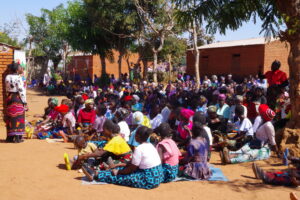
In the face of rising economic pressures and skyrocketing agricultural input costs, rural communities are finding innovative ways to achieve self-reliance. On Wednesday, June 10, 2026, Rhema Institute for Development took a significant step forward in this mission, hosting a massive community engagement session focused on financial literacy, business mentorship, and climate-smart agriculture at Sendeza Village, Mtengowanthenga, in Dowa District.

The targeted awareness session brought together over 500 beneficiaries representing 44 local clubs, all eager to learn how to strengthen their Village Savings and Loan Associations (VSLAs) and integrate sustainable farming practices into their household economies.

For many rural households, VSLAs serve as the primary gateway to financial inclusion. However, saving money is only the first step toward economic mobility. To truly break the cycle of poverty, these savings must be backed by sound business strategies.

Speaking during the engagement, Rhema Institute Project Officer Victoria Mbewe emphasized that financial literacy is the true cornerstone of resource mobilization and grassroots economic empowerment.

“Financial literacy is the ultimate tool for self-reliance,” Mbewe shared with the gathering. “But saving money is only half the battle; our members must also know how to grow it through structured, disciplined business ventures.”

Mbewe urged participants to approach entrepreneurship with strict financial discipline and a proactive mindset. Crucially, she highlighted the necessity of conducting thorough market surveys before launching any business enterprise—a practice that ensures beneficiaries invest in viable markets and safeguard their household incomes against avoidable losses.

For Rhema Institute for Development, the integration of business mentorship and marketing linkages into traditional VSLA models represents a strategic paradigm shift.

Historically, grassroots savings groups have excelled at helping members accumulate small pools of capital. However, without a clear roadmap for investment or direct access to profitable markets, these funds often stall. By deliberately embedding business mentorship into the program, Rhema Institute provides entrepreneurs with the critical acumen needed to manage risks and optimize profits.

Furthermore, establishing marketing linkages bridges the gap between rural producers and competitive buyers. This holistic approach ensures that local initiatives do not operate in a vacuum. Instead, it transitions communities from basic economic survival to sustainable, long-term wealth creation, transforming grassroots savings into vibrant, self-sustaining local economies.

The economic challenges facing Dowa’s farmers extend beyond capital; the escalating cost of commercial farming inputs threatens food security across the region. Addressing this crisis head-on, Limbani Chiusiwa, one of Rhema Institute’s dedicated Village Agents, introduced a powerful, low-cost solution: producing highly effective bio-fertilizer using human urine.

Chiusiwa demonstrated practical methods for preparing and safely applying this organic alternative, showing farmers how they can dramatically boost their field crop yields without relying on expensive commercial brands.

“With skyrocketing commercial fertilizer prices threatening farming impacts in the district, we must look inward,” Chiusiwa reminded the community. “Utilizing locally available resources allows our farmers to cut costs, maximize yields, and safeguard their food security.”

The deep, structural transformation witnessed across these 44 clubs would not be possible without the unwavering commitment of Rhema Institute’s donor partners. Their generous financial and technical backing provides the fuel for these grassroots interventions, turning ambitious developmental concepts into practical, life-changing realities on the ground.

By investing directly in financial capacity building and climate-smart innovations, these partners are helping Rhema Institute move away from short-term relief toward sustainable, measurable growth. This collective generosity is actively creating a massive, positive ripple effect in Lilongwe and Dowa District with one household, one village, and one savings group at a time.

By combining financial discipline with adaptive, climate-smart agricultural techniques, the over 500 beneficiaries in attendance left the session equipped with both the knowledge and the practical tools needed to build resilient households.

Through these deeply integrated interventions, and with the vital support of its global and local partners, Rhema Institute for Development continues to demonstrate that when rural communities are provided with the right mentorship, innovative tools, and market connections, true sustainable development is born from within.